Showing posts with label sailing in the dark. Show all posts

Tuesday, May 20, 2025

The 4 Rules for Surviving Long Passages

We lined up for the mooring ball again. I reached as far as I could with the boat hook; not far enough. I was yelling into the headset BOW TO PORT, BOW TO PORT as we drifted past it, out of reach, a third time. Lance was frustrated, yelling back THE BOAT STILL WON'T RESPOND. We were drifting down onto the neighboring boat in the crowded mooring field. Her crew was alert on deck, hands on hips (this pose is known among cruisers as Bitch Wings, and in this case we deserved it). Our shouting had raised the attention of the other neighboring vessels, their crew were also standing on their decks, eyes wide, enjoying the drama but also hoping not to become part of it. There was a smattering of Bitch Wings in the crowd. Surely we looked like newbies. Or, even worse, credit card captains. A helpful neighbor took pity on us and dinghied out to wait at the ball to help us loop through it.


Night Passage to the Dominican Republic


Brain cells started to sluggishly click into place. There was just not enough wind for Minerva to be fighting us like this. Something basic had to be wrong. That's when we noticed the mizzen sail was still up. Doh! No wonder the boat wouldn't turn - we had a sail on her tail acting like a big wind rudder. A quick release of the mizzen sheet and the sail relaxed, Lance regained close-quarter control and we slowly approached the ball, I handed the mooring line to our new friend on his dinghy. Minerva was secured.

As always, we did the post-mortem over a cold beverage when emotions had calmed and flop sweat had dried. How did we get here? How did we become the day's entertainment?

We broke rules #1, 2 and 3. That's how.

RULES FOR A SUCCESSFUL PASSAGE

  1. Keep it Simple. You will arrive tired. Do everything you can in advance. 
    1. Study the chart
    2. Know the arrival rules 
      • Can you rest when you arrive or does Bureaucracy insist that check in  happen immediately
      • Have your paperwork in order, ready to grab and go
      • Know who to call or where to go (and in our case, where can the dog pee like right now right now right now)
    3. Have a backup plan in place in case your planned arrival location doesn't work out
    4. Assume everything you need on passage will be difficult to dig out in the dark or when tired, pull it out so it's handy or at least think through how to put hands on it in the dark
  2. Sleep when you are not on watch. No reading, listening to music, watching videos, texting, no working on the laptop unless these things actively contribute to making you sleepy. Not tired? Doesn't matter. Lay down and try to sleep anyways whenever you are not actively on watch. Tricks like imagining your body going numb one portion at a time, or acknowledging and actively releasing intrusive thoughts without giving them real attention are helpful.
  3. Be Kind. The rest of the crew will also be tired, and brains will not be functioning at 100%. Be gracious. Check one another's work, two heads are better than one.
  4. Prepare One-Handed Meals in Advance. A hangry crew doesn't behave well. This one has saved our bacon time and time again when conditions went sideways and hangry started rearing its ugly head and heading towards total assault on rule #3. Most memorable was the passage from Curacao to St. Croix when the autopilot went out forcing us to hand-steer for the last 30 hours, that one-handed meal prep was a lifesaver.
This particular trip was a dream ride along the North Coast of the Dominican Republic. The first day we encountered the typical confused seas of the Mona Passage, and the wind and swell were both much more than predicted but still manageable. By the time we reached the Dominican Republic side of the Mona, the swells started to soften and lengthen into a very comfortable lazy stern swell, sometimes with agreeable current. We traded the jib for a spinnaker and sailed that way all of day #2. Sometime in the night on the home stretch the wind completely died and the spinnaker was put away, the engine deployed and the mizzen tightened down. We came into Luperon that way, after a little over 50 hours at sea. Lance hadn't slept well. We were fixated on the fish pots reported to lurk around the bay entrance the last hour or so and neither of us remembered to take the mizzen sail down (rule #1, should have done it in advance when the sun first came out, and before we reached the fish pots. We were busy drinking coffee instead and completely forgot our trusty mizzen sail on flopper-stopper duty out back).

So we were the afternoon's entertainment. So what. There wasn't any damage, and everyone's been there. Luperon is a tight cruiser community, word has surely gotten around by now about the dorks on Minerva. We'll go to the Thursday mixer and take our lumps.

Spinnaker Sailing is the Best

Wednesday, April 26, 2023

Puerto Rico and the End of the Thorny Path

After one of my Facebook posts someone asked me what the "thorny path" meant. I probably should have detailed that out at some point, so please accept my apology and let me explain.

Sailing is preferable if the wind is coming from your side or somewhere at your back. Same goes for waves. The more in front of the mast either of these items the bouncier the ride.

The third variable: current, can generally be used to a sailor's advantage if the trends are predictable.


Impromptu Buddy Boats on the Mona Passage with us. We weren't the only folks that spied a weather window and made a run for it. We established a VHF channel to discuss strategy, right about here we'd decided to push further away from shore to find calmer wave action and avoid encountering fishing equipment in the dark.


Going from Florida to the Caribbean means going directly against the trade winds, which almost always blow from the East, stronger in the afternoon. The current and waves in this region also generally come from the East, or slightly North of East. And there's a lot of East to be conquered to get from Florida to the Caribbean. So the wind, waves, and current are generally fighting any progress. There's a lot of motoring - the sails don't get out much. That's the essence of the thorny path. Lots of motoring and regular beatings.


Boqueron Still Life on a Monday morning


Experienced sailors all say the same thing about the thorny path "did it once, won't do it again", and instead sail waaaaaaaaay out of the way in a really big tack out into the open Atlantic Ocean, and sail back into the the BVI on Longitude 65. This method is called "taking the I-65". But we wanted to experience the Dominican Republic and Puerto Rico, and also Chloe still won't pee on the boat making regular landings important, so we decided we'd give it a whirl. After all, others have survived, how bad could it possibly be?


The Fort at Old San Juan


We planned all our hops through the Bahamas trending South and East, and then fought our way along the Dominican Republic coast, where we perched on the East side of the island and looked out over the Mona Passage to Puerto Rico. Famed waters, these are. Any sailor who has experienced this passage will take a big breath and pause before telling you their personal horror story.

By the time we reached the Dominican Republic the signs of stress were starting to show on the sailors around us. One couple put their boat up for sale. Another threatened divorce. A single-handed sailor put his boat on the hard for a season to "go home and think about it for a while". Many got sucked into major boat repairs or marina life and stayed longer, then longer, always finding a reason not to leave. That last one tempted us too. The Dominican Republic is affordable to cruisers, the fresh food is plentiful and the people are friendly. But in our case the insurance company won't have it - they want us South of Latitude 12.40 (the hurricane belt) by July 1st. So we had to keep moving.

BBQ at Los Pinos, on the mountaintop Ruta de Lechon (pork route)

In the end the Mona Passage was every bit as awful as we'd heard to expect: the pokiest middle finger at the end of a very long thorny path. We were advised not to try to play the currents as their timing was simply unpredictable. We studied the wind and wave patterns very carefully, integrated advice from the weather and local sailor gurus, and still got our asses handed to us by wind, waves, and most of all the current which slowed us from our usual cruising speed of 6.5knots to 3.5knots, extending our time in the wave beating zone by hours. Fortunately Minerva is a sturdy girl and the only casualty she suffered was some trimwork that had to be reattached after arrival. We received only minor bruises that healed quickly.

Shortly before arriving in Puerto Rico in the middle of the night, the wind and waves finally released us and we motored into the anchorage on a glassy sea, a surreal experience. The smell coming off the island of Puerto Rico from the earlier rainstorm was grass and dirt, agriculture and wet sidewalks. In short, it smelled just like a baseball field. The sweat flop had barely dried on our skin when we set the hook in the protected anchorage at Puerto Real and passed out flat, dreaming of childhood days playing at parks.


Ah! That new outboard smile!


Shortly after sunrise our first morning in Puerto Rico the music started. And didn't end until after we'd gone to bed each night. Everywhere in Puerto Rico there is music; all the time from every jetski, every car, every boat. Happy bouncy music and it's all very LOUD. We ordered a new outboard from the local chandlery and settled in to wait for its arrival while the Spring Break insanity unfolded around us in Boqueron, a popular public beach and party town.


These little pouches of deliciousness are called Gasolina and they are made in Puerto Rico. We coined them "adult Capri Suns", they are booze in a squeeze pouch - the perfect way to end a sweltering day. Very little sugar, small enough to keep a few in our tiny freezer, they store in the bilge with no fuss. Lance is addicted to these things.


Continuing East along Puerto Rico's coast meant doing so at night to avoid fighting the tradewinds, and so that was our pattern. Go to bed early, anchor up in the dark, motor in the dark, arrive in the morning light and set the hook, do it again.

Puerto Rico has plentiful US post offices. Huzzah! Finally we were in a position to catch mail from home including a great big bag of flags. These are the flags we are likely to need between now and Christmas, the rest are stowed away for use in 2024.


Then we reached Salinas and received an unexpected miracle, West Winds at 10am and flat seas! We hoisted the spinnaker and reveled in the free ride as far as it would take us, landing in Culebra and setting the hook alongside our buddy boat at midnight. A few days later we made the short hop to the USVI on calm seas in full daylight. And that's the end of the thorny path. We made it. Boat, relationship, and bodies intact. Whew.

Spinnaker sailing! Yeah baby!


 It was an experience, and now we are sailors who will say "we did it once, won't do it again". The dog will just have to finally give in and pee on the boat. She has a pee pad and she knows what we want, she's just stubborn.

The turquoise waters of the USVI remind us of the Bahamas. There are a couple of turtles that pop up for air, we'll go snorkeling after them tomorrow. But first, a cocktail and a toast buh-bye to the thorny path.


Wednesday, March 8, 2023

Goodbye Bahamas


Around 1 am Lance woke me up for my turn at the wheel. When I came up on deck I was greeted by the full moon and glassy seas, Minerva's trusty engine was humming contentedly and we were zipping along at 6.7 knots. There were a few fluffy clouds but the air felt dryer than usual.

Lance mumbled something about the radar overlay before nodding off, so I switched the view on the chartplotter over to check it out. Nothing but nothing. Well, except that one island just before our turn 4. Little Inagua, our last contact with the Bahamas island nation.

Fruit trees line the beach on Acklins Island. Research leads us to believe this one might be a "Five Year Apple"

Little Inagua is 50 square miles and completely uninhabited. We are passing it on our way to the Dominican Republic, and it seems like a natural touchstone for a lot of other passages too. We will come within a few miles of it, and I can't see it. At all. Nothing. Eerie. Even the cloud cluster that normally betrays every other Bahamian island location is missing.

Once again I muttered under my breath "Would it kill you to put a light on this thing? A marker? A bell? Something?"

Interesting sponges on Acklin Island

And I am struck again by how grateful I am to be doing this adventure with today's technology. I have full confidence in our chartplotter. Still, some visual or audio confirmation would be welcomed.

Without a chartplotter, we would have laid out this course on a paper chart and kept our eyes glued to the compass and the clock to ensure we remained faithful to the plan. Right about now, without visual confirmation, I'd be freaking out that we had miscalculated, and probably sweating and swearing a little bit. Maybe a lot.

Instead, we glide by it in the darkness while I nibble on a cookie and pet my sleepy dog. Goodbye Bahamas.


Sunday, February 19, 2023

Magic on Mackie Shoals


Dave pointed to a spot on the chart in the middle of nowhere. "We'll spend the night here".

I zoomed out the chart, and then zoomed it out again. There was no island anywhere nearby. The spot Dave pointed at was 37 mi from the backside of Bimini, and 50 miles or more to Chub Cay or Andros. I squinted my eyes and chewed on my lip. This goes against everything I know, but... this is our buddy boat and they have been here many times. They know the area. We do not. Why even have a buddy boat with local experience if you're not going to trust their guidance?

And the conditions did look perfect for it. Light winds in the morning going our way, then 2 days of peaceful calm.

And so began our journey to Mackie Shoals.

Beachscape under sail

The next morning we motored out of Bimini. As we approached the shallow sandbar that separates Bimini from the outside world, Lance was behind the wheel and I was perched on the bow watching carefully for any random coral that might cause trouble to Minerva. A giant ray glided past, and I could see the individual sand as we motored over it. In the Bahamas the clarity is such that you can see this level of detail even in 15 ft of water, so it all has the effect of looking alarmingly shallow. We followed our track out, made the sharp turn across the shallow shoal (holding our breath as if that somehow makes us lighter), and exited safely out into the open ocean. Minutes later we had Minerva's sails up.

As we turned East around the North side of Bimini, the royal blue water turned to turquoise and stretched on as far as the eye could see. Soon the depth readings under the boat were showing at a steady 10 feet. We sailed alongside our friends and other boats that followed us out, until the wind died as predicted at midday, then we fired up the motor and made some ice to stow away for the evening's cocktails.

Godspeed followed us out of Bimini and sailed along with us for a while

With nothing but turquoise water and blue sky in every direction for hours, it seemed out of place when we finally did come upon a lit marker and a few boats already at anchor. It's all 10 ft deep in every direction, and it's not like there are proper channel markers, it's just more or less casually understood that the direct line between Bimini and Chub Cay is the preferred highway, so we motored about a mile or so out of the way and dropped the hook at the outer edge of the other boats already anchored there.

I was still tidying up the boat from the journey when I heard the splash of Lance swimming. Cocktails and dinner soon followed, and that sunset disappearing into the beautiful turquoise water was something I will never forget.

Beachscape at anchor on Mackie Shoals

In the Bahamas cruisers show their appreciation for the sunset with the blow through a conch horn. Since we don't have one we make do by ringing the ship bell or howling with Chloe. 

Our buddy boat Beachscape in the late afternoon light on Mackie Shoals


Then the evening show began.

We brought the cushions and cocktails up onto the aft deck to witness the stars. So many stars; more stars than I've ever seen ever before. With no visible land in any direction, there was simply no light pollution. All the stars were so bright we couldn't even make out the constellations we're used to seeing.

We counted shooting stars and satellites until we passed out lying under the blanket of stars.

It was the most magical night.

As predicted, there was no wind the next morning and we motored the rest of the way to Chub Cay. For once, Lance wasn't grumbling about the motor running instead of the sails being out. We happily sipped our coffee as we motored along on the flat seas, both still under the spell of those crazy stars and a magical Bahamas night.

Motoring to Chub Cay with the sunrise on flat seas

Friday, October 21, 2022

The Jersey Jump

Now where was that stupid charger? I had already torn the boat apart from bow to stern, seemed silly to do it again. It had to be hiding in plain sight.

So I went back through the electronic closet again and sure enough, there it was - pretending to be the charger for something else, when it actually belonged to the big flashlight. Aha! It was going to be a very long sail today, definitely an overnighter, gotta get some juice in that flashlight!


The Coney Island Light

Probably wise to look around at the other emergency equipment too. The little lights attached to our life vest are all charged and ready to go, they will come on automatically if wet. Snacks are prepared and standing by. Radio was working well, backup radio on standby and charged, inreach tracking and broadcasting our location, chartplotter and iPad playing well together, backup iPad charged and ready to deploy. Hopefully we never need any of this preparation, but we do it anyway.

We settled into easy shifts, taking turns at the helm while the off-duty crew napped.

Somewhere around 2am we lost all the wind, exactly as predicted. So we rolled in the headsail, tightened up the main and mizzen, and fired up our trusty new Beta. As Lance drifted off to dreamland I found myself obsessing over a weird collection of white and yellow lights offshore. It sort of reminded me of the big container ships we frequently encountered off the coast of Long Beach, CA, difficult to tell which direction they were going without visible red or green lights, just a mass of indecipherable white and yellow.

For a while they kept pace with us, sometimes veering away from us, sometimes getting closer. As we approached Atlantic City the vessel made a definite course change and the chart plotter started blaring alarms - we were on a collision course. I turned off the audible alarms and kept an eye on it, we were on a steady course and they were not changing course either. The GPS predicted that we would crash into one another within the hour.

Barnegat Light, on the Jersey Shore

As we drew closer, the vessel name popped up on the AIS - the Jersey Devil. A little more online research revealed it to be a fishing vessel, which gives it the right of way since we are motoring. I could have slowed down and passed behind it but if it was long line fishing... we do have a line cutter on our prop. I hope to never test it.

My thoughts drifted back to the story our friend told us last summer about the Jersey Devil as we passed by the family home built in the 1700s. He was the 13th child born on a stormy night and was greeted with disdain, until one day he reportedly turned into an actual devil, flew out the window and into the swamp where he was, and still is, blamed for all kinds of mischief.

Well, this devil with the strange lights and indecipherable intentions wasn't going to worry me. I picked up the radio and we worked out a deal, I would speed up and he would slow down and we would miss one another with no course changes. As he passed behind Minerva I noticed the lights that looked so strange from head-on were attached to huge outriggers, so it's good that I didn't try to pass behind him, he probably WAS dragging nets or lines. At least all of the weird motion offshore made sense now. Fishing activity. Now I know what that looks like in the dark: random. It looks totally random.


Atlantic City, NJ


Lance came up for his turn at the wheel as we left Atlantic City and the Jersey Devil in our wake. All the stars were out, and the breeze was starting to pick up a little bit. We debated sailing across the mouth of the Delaware Bay to our intended anchorage at Lewes, but ultimately decided since we were likely to encounter container and fuel ships en route to Philadelphia in the channel, and since the current would be against us and the wind was still slow, we would just motor the rest of the way, it wasn't far and keeping the motor on would reduce our exposure to the large fast-moving vessels.

Now, we both know the rules, it's best not to approach shore at night, but we felt confident here. We had been here before, the chart plotter was behaving and seemed to line up well with the markers, so onward we pushed, although Lance did reduce speed as we passed the breakwater wall. There should have been plenty of room between the end of the breakwater wall and the shore, imagine our surprise when we ground to a soft but sudden halt. According to the chart plotter and the markers, there should have been thirty feet or more between us and the shore. Surprise!

Remember that flashlight? Yeah... It revealed shoaling quite far out into the channel. Certainly beyond all indicators. Sometimes you do everything right and you screw up anyway. Freshly charged flashlight to the rescue - escape route revealed.

A friend once told us of a "good captain box" theory. All the little things you do to check, recheck, make backup plans, rest, buy and maintain top of the line equipment - it all goes into this imaginary box. And now and then when shit goes sideways, you hope that you put enough good things in the box to make a difference.

Jersey Devil vs AIS and a good radio, win.
Delaware shore vs flashlight, we'll call that one a draw.


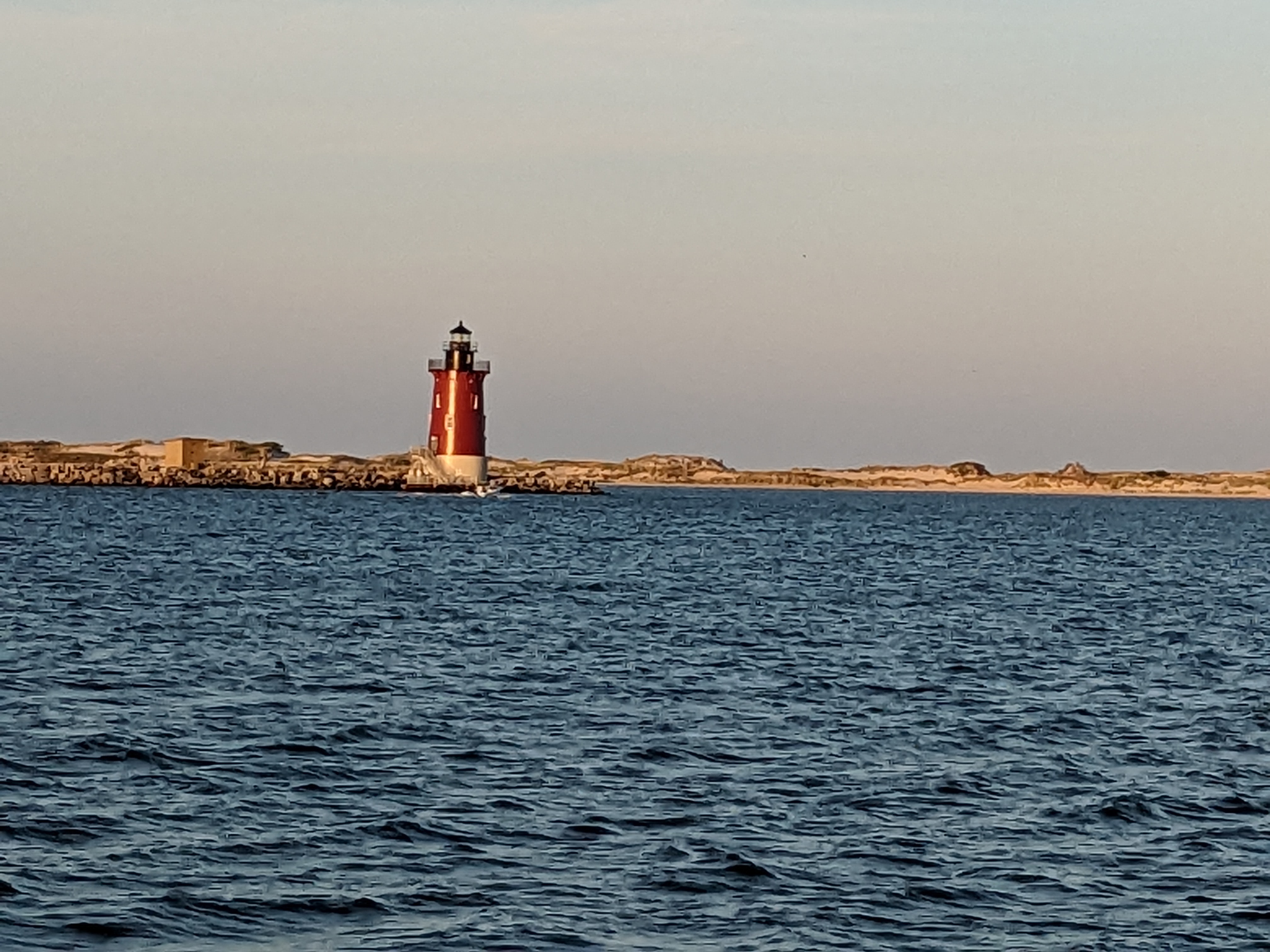
Lighthouse at Lewes Anchorage

Tuesday, September 20, 2022

Passage Planning

The goal for every sailing day is good wind, minimal swell, cooperative tide and current. There's a lot that goes into passage planning to make all of this come together.

The first step is to pick your route. In this case, we are jumping around the outside of New Jersey, heading South in the open Atlantic. Our route will take us against the generally prevailing swell and wind, so we are looking for that rare window when the swell is minimal and the wind comes from anything other than its usual direction. 

Our first intent was to leave on Friday, because it had a speedy tailwind. We would be truly flying! Our friend Al told us last night he wants to leave on Tuesday (today). Let's compare the days.


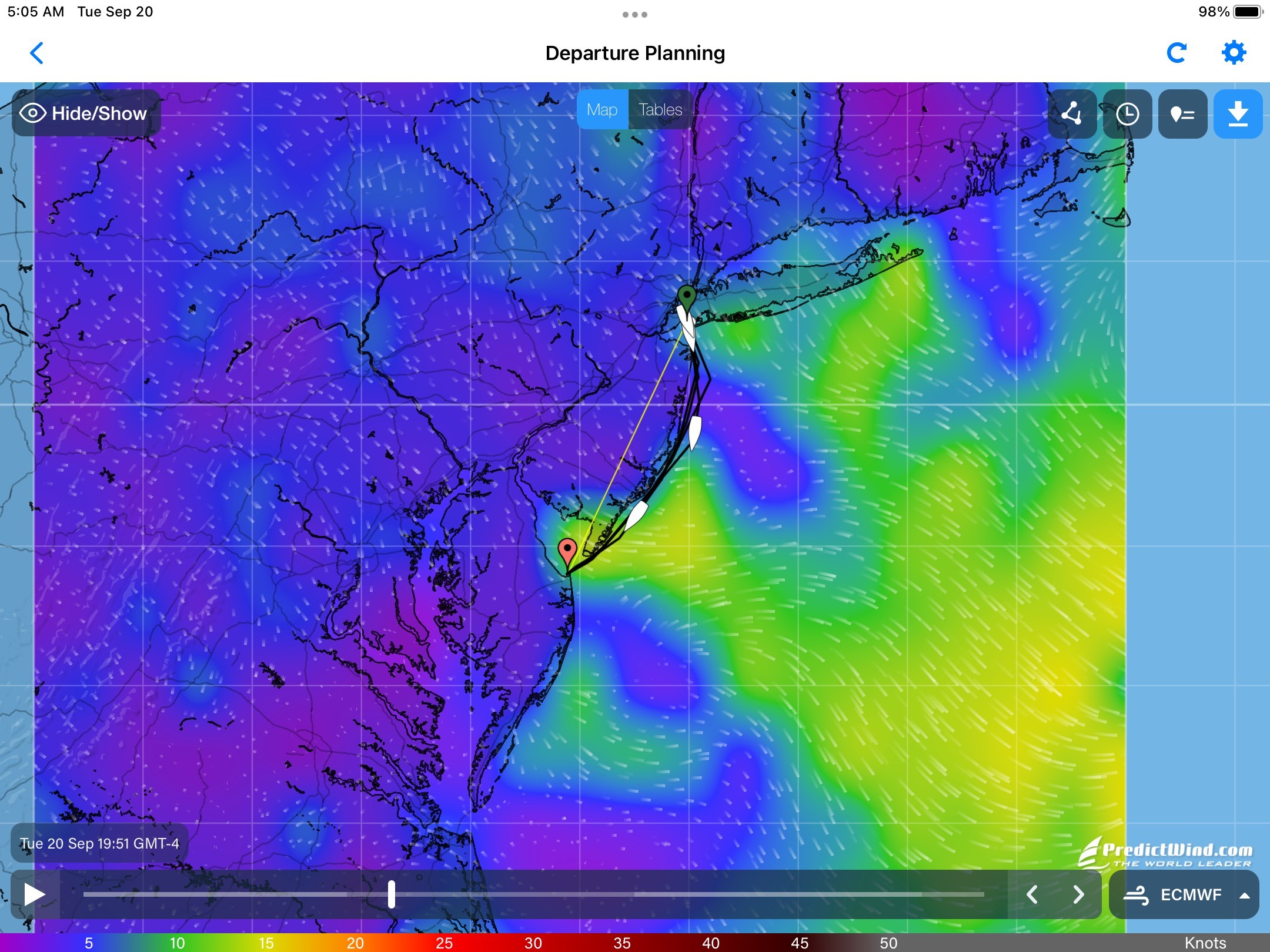
Wind: this is Predictwind's Friday routes. The second boat which represents a noon departure would have 20-25 knot broad reach winds most of the day. 

Predictwind's Tuesday wind routes: The first boat which represents a 7am departure would have mild-moderate run and reach winds most of the day, with a lull in the middle of the passage which will likely require some motoring. Later departures the same day are much the same, light winds with some motoring required.


We use a variety of tools for planning. We usually start with Windy.com to get an overview of generally what the wind and rain are planning. In this case there is a high pressure over New York which is rejecting the approach of the offshore hurricane Fiona. On Friday the remnants of a storm currently hitting California will arrive here, bringing strong winds from the NorthWest.

The latest addition to our toolbox is PredictWind. It took us some time to set it up with the tolerances of Minerva and her crew, and like any new tool the more energy we invest in it the better we can make it work for us. With the weather routing enabled, we can find the best travel windows.

Then it's back to Windy to check the swell. It's no fun beating into big waves. PredictWind may have a swell overlay as well, I haven't explored that yet.

Friday's swells as seen on Windy. Ugly.

Tuesday's swells. Minimal.


Now that we've compared the two days, it's clear that Tuesday is the better choice. While we won't be sailing as fast, we also won't be banging into 2-3 meter waves. We may have to motor for a little while in the middle of the trip, or we may be able to sail it all with the light spinnaker. Worth it to take less of a beating.

Lastly, we pull up Savvy Navvy to check the tides and currents. Sometimes we have a skinny water exit from our overnight anchorage. If we can't get out of the harbor to meet our window, we need to move the boat for better staging or start all over again with a new window that lets us escape on time. In this case there are no worries.

The tide setting on Savvy Navvy will help plan for depth throughout the day, just slide the time bar to your projected window. Particularly important when the anchorage entrance is skinny or there are currents to plan around

Lastly, plug the route into the chartplotter, and we're off! 

This will be our longest single passage ever and we are quite excited about it.

Just in case the weather predictions are all wrong we picked a bailout point at Atlantic City. We've been to both our destination in the Delaware River and also Atlantic City before and we are comfortable arriving to either place at night.

See you on the other side!