Showing posts with label ICW. Show all posts

Sunday, May 30, 2021

The ICW, Virginia Cut, Great Bridge and Annapolis

The Alligator River Canal

After leaving Bellhaven we cruised the Alligator River, encountered our first swing bridge, and pushed on across a stormy Albemarle to tie up safe and exhausted at the Coinjock Marina. We decided to stay there for a couple of days to recover, enjoy their famous prime rib, and then motored on through the beautiful marshlands to the free docks at the Great Bridge.

The public park at the Great Bridge, perfect for long dog walks

At Great Bridge we were treated to a quiet and peaceful park perfect for long dog walks along the river, and giggled at the honking geese expending great effort to keep all their young together as they clumsily learned to negotiate the river banks and swim.

We were going to just stay the one night, but dark clouds rolled in so we decided to stay an extra day, and used our rainy downtime day to visit the Great Bridge Museum.


The Great Bridge is historically significant because it was the site of a great Revolutionary War battle in which the spunky and wily settlers conquered the mighty British Army, despite being outnumbered and significantly outgunned. The last villager to retreat off the bridge was Billy Flora, who bravely pulled the wooden planks off the bridge behind himself to further slow the British advance. By maintaining control of this bridge, the colonists denied British reinforcements that might have turned the tables on other other important battles in the region as well.

The Great Bridge is a drawbridge which opens on a schedule tied to the raising and lowering of the lock right behind it. On one day we counted 16 boats stacked up waiting for it to open.

While we were resting here we met cruisers from Camden Maine who were on their way home after an extended trip through the Bahamas. This part of the ICW is part of their annual route, and so they suggested we follow them through our first lock and the craziness of Norfolk VA the next day.

Our first lock had a difference of only 14", and was easy to negotiate.


Passing beyond the Great Lock signifies the end of the wind-driven tides and the beginning of the lunar tides, which are much more predictable. And finally some deeper water.

We met this fuel tanker in our lane. We decided to let him have the whole thing.


We scurried to get out of the way of a fuel tanker that surprised us around one bend, its two tugs pushing and pulling it into place for fuel off-loading. We waited for quite a long time at a railroad bridge so long trains of cargo and fuel could go by, Minerva dancing in circles to keep her place in line despite the current and the wind.

Commercial vessels such as this Core of Engineers ship always get the right of way at the bridges so it's a solid tactic to find one and keep up if you can for quicker green-lighting through the locks and bridges. The Core of Engineers maps the depths of the ICW and makes dredging recommendations. We are always happy to see them and are grateful for their service.


Norfolk has a military base and also a ship-building yard and there were several military and cargo vessels in various stages of build-out. After so much time in the quiet little village of Oriental and the timeless travel in the tranquil marshland beauty of the ICW, Norfolk was an assault on the senses; between the industrial smells and the cacophony of normal city life and the banging and clanking of the shipyards it was totally overwhelming. We set the hook at an approved anchorage just off of Hospital Point and were surrounded by city lights and noises and absolutely huge vessels moving around. The next morning I paddled Chloe to the tiniest snippet of beach in front of the hospital where we were greeted with big "no trespassing" signs... too late the dog was already off the SUP and frolicking on the sand. We paddled immediately back to Minerva and took off to Yorktown.

Minerva in Yorktown

The marina parked us alongside a day cruise commercial sailboat, we didn't know it at the time but it turned out to be the very same boat that sparked a dream of sailing for our friend Emily, who is now a liveaboard boat owner too.


A small cruise boat is nearly always parked here. Because we were sharing this dock with two professional cruise boats, many of the passengers came by to ogle Minerva too. More than once from inside our sailboat we heard "ooooh let's go out on Minerva instead". Yeah... no. Get your own boat.


Lord Nelson's house, Yorktown, built around 1730


Yorktown also has significant revolutionary war history. Once upon a time it was the place through which all colonist-made products were routed for tax purposes, the primary export for this region being tobacco, making it ground zero for the boiling resentment between the colonists and the British who established a Navy presence there to try to keep a lid on it. The subsequent battle here was won by George Washington and French allies, and visible holes remain on the hillside from the cannon and musket fire all those years ago.

The day we left Yorktown we crossed the wake of the original Jamestown settlers, one of my bucket list items, and we were out in the Chesapeake. And, alas, still no wind.


This is the Chesapeake Bay Bridge Tunnel, which looked weird on the charts and even weirder in person. Off to the left of the picture the pier legs support the bridge the cars drive in on, and they disappear into the tunnel behind that brick building. I wonder how many cars we motored right over.


Escaping this skinny water marina meant a 5:30 am departure. Tides wait for no one.

For most of our voyage to Annapolis from Oriental, we had either no wind, wind directly on the nose, or no room in the channel to maneuver, but we did eventually find amenable wind and put up the sails.


The anchorage in Galesville is also the starting point for the Wednesday night beercan races. We became an obstacle for the racers as they jockeyed for the best starting position.


Chloe stopping to smell the flowers at Solomon Island


Surreal late morning light bathes the Smith Point Lighthouse at the mouth of the Potomac


Coast Guard and Navy ships abound in this region, and there is always something interesting going on. On our way into Solomon Island we saw three fireboats practicing.

And then we rounded the corner, and we were there.
Annapolis. Finally.

Bert Jabin Yacht Yard, home for a month

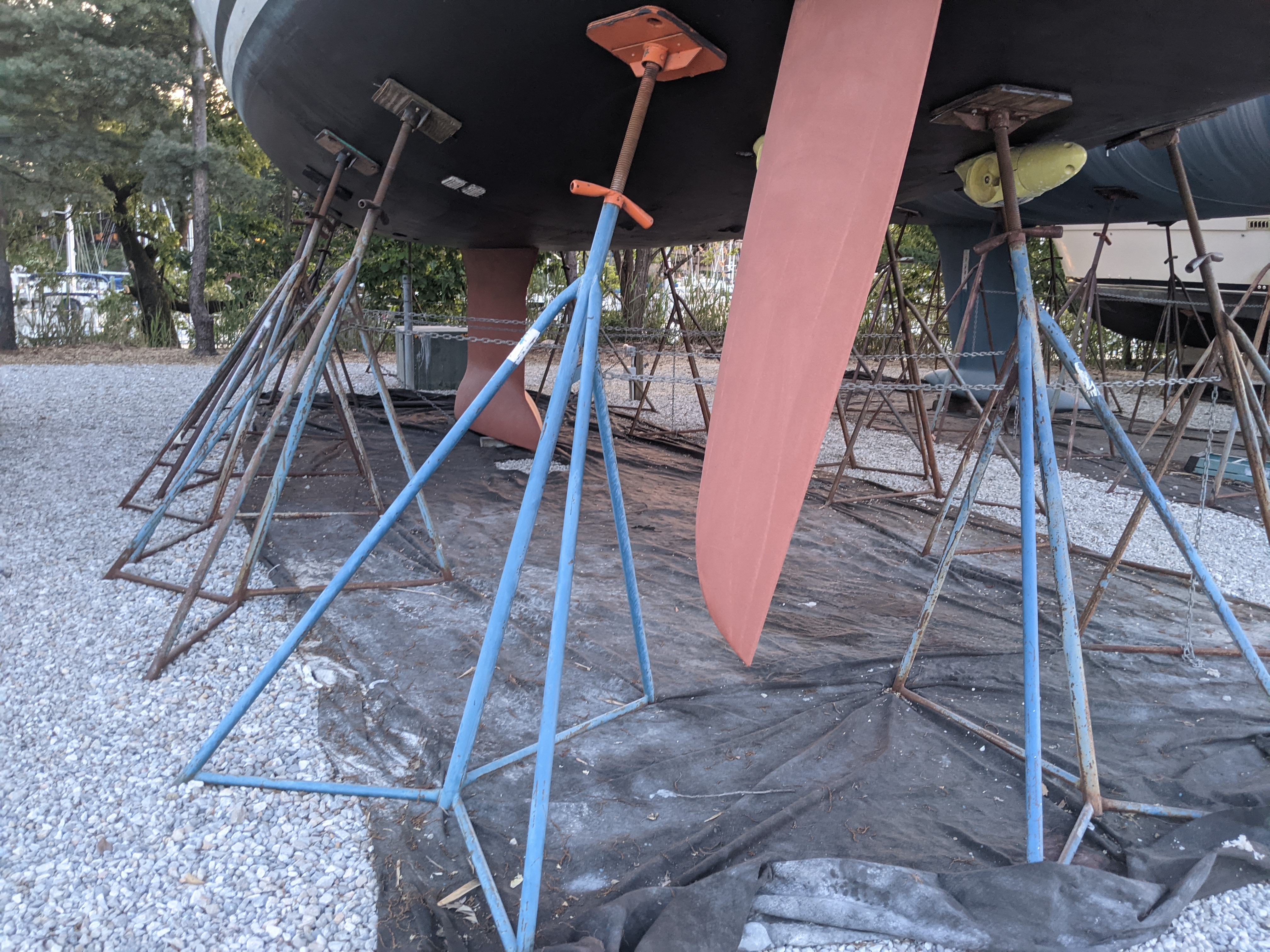
We settled into a slip on G Dock at Bert Jabin Yacht Yard. This place is crazy busy. They store boats on the hard, using travel lifts and huge forklifts and a mountain of jack stands. Everything you need to get work done on your boat is here; professionals ranging from gel coat repair to diesel mechanics roam freely throughout the property.

Sling lifts and oversized forklifts at Bert Jabin Yacht Yard

Boat rests on the hard, still wearing its winterized shrink wrap despite the May heat


A forest of jack stands supports an assortment of boats on the hard 

On Tuesday we were shaken to the topsides with loud noises, the Blue Angels were practicing for the Naval Academy commissioning ceremonies by doing repeated low flyovers right over our heads. It went on all day. It was so loud. And so awesome. On Thursday our friend Ceri came to visit and we went downtown to an outdoor restaurant downtown and were interrupted from our cozy conversation by a great cheer from everyone seated in the area. The Blue Angels were walking amongst us in blue coveralls with yellow stripes. We tried to follow them into the bar but the crowd swallowed them up.

Painkillers at Pussers

All quiet between storms on the G dock

Minerva needs a new fuel lift pump, we'll settle here for a month or so and swap it out. This seems like the right place to get it solved.

Saturday, May 8, 2021

Let Loose From the Neuse That's Kept us Hangin' About

Then Thursday night the bike sold. And that was it. The last thing holding us on land.

Goodbye Oriental NC

Stuff sold: check. Covid shots: check. Friends hugged goodbye: check. Boat as safe as we can make her: check.

Two sailors, one dog, one big sailboat, ALL IN on this new adventure together.


On Friday morning the winds started early. With our coffee cups in hand, we watched in horror as the water levels started free-falling and threatened to strand Minerva in the mud again. We abandoned our coffee, Lance fired up the motor and started removing lines. There were a few stubborn lines. Jen, a friend and fellow sailor, got a splinter in her finger while helping us free one of them, and donated a little blood to the boat. Last superstition handled: with the sea gods appeased (thanks Jen) we were on our way, off into the Neuse River...

Where we were met with strong headwinds and a nasty little 2' chop. Oh well. No sailing for us today. Good thing Lance and our favorite mechanics have been dishing up all the lovin' on Minerva, the new transmission and well-serviced engine hummed along happily. We fought our way up the angry Neuse River and into the protected waters of the ICW then onto the the Bay River, Goose Creek, the Pamlico River, and up the Pungo River to Belhaven NC. Altogether we covered 42 miles of rivers and ICW.

As we were leaving the Neuse River behind Lance sang a line from AC/DC's song Back in Black: let loose from the noose that's kept me hangin' about. And I sang it all the way to Belhaven.

Goose Creek, the ICW, leaving the Neuse River


For those of you that aren't from the East Coast of the USA, ICW stands for Intra Coastal Waterway. It's a series of barrier islands, lakes, and rivers that were connected by canals long ago to make one long navigable waterway connecting small villages to the sea and thus to profitable business ventures. It goes from Florida to the Chesapeake and is a great way to make relatively safe short hops without committing to the open ocean weather conditions. The government dredges it to 10' regularly but it shoals up quickly, so a sailor isn't guaranteed to find 10' even if remaining meticulously in the channel. There are several bridges and each has its own set of rules about opening. All of this requires constant research and attention. Minerva needs 6'2" of water not to scrape her belly in the mud and 55' of air not to bump her mast. We have scurfed our fair share of ICW mud, and although the bridges we have encountered thus far are all clearly marked at 65' it looks like we will crash into every one. From the deck it's absolutely terrifying to look up at the mast and the underside of bridges - one sailor told me he just doesn't look; can't look up, his heart stops every time. I laughed when he said it, now it happens to me.

Belhaven NC as seen from our anchorage just outside the G11 marker

We landed in Belhaven NC just ahead of a parade of thunderstorms. We dropped the new Mantus anchor in 11' of water, set it well and paid out plenty of scope. We were expecting big winds the next day it was time for it to prove its trustworthiness. I set the anchor drag alarm at 100', and mirrored the chartplotter to the ipad so I can take the anchor watch screen to bed and monitor it obsessively throughout the night.

As soon as we were anchored the first rainstorm washed over us. And rinsed our deck clean. What timely and friendly service!


The green circle represents the anchor drag alarm, if we move outside of the circle alarms go off. As you can see the Mantus is holding us well, and as the wind shifts Minerva makes a half circle around the anchor.


Chloe hasn't embraced her lawn pee patch yet so for now we need to run her ashore for breaks. I can do this from the stand-up paddleboard on peaceful waters but I can't make headway with the dog on the board if the winds are high.

At the moment we still have two dinghies aboard, our porta-bote with an electric Torqeedo motor and the rubber inflatable that came with Minerva and a big outboard. Eventually there will likely be only one, we're not sure which setup we'll keep yet. For now we wanted to take the rubber dinghy out, since we haven't played with it much, and since it's a short ride to the town's dinghy dock the Torqeedo could use a test run too. It has been 3 years after all since it last got any real exercise, now is as good as anytime. Best to bring the oars, too, just in case.


Hiding out from rainstorm #2 on borrowed chairs

Although the wind had already started kicking the second storm hadn't released rain yet. We landed at the dinghy dock just ahead of the second storm, and hid out from the driving rain, thunder and lightning under a storefront awning with some Adirondack chairs we snagged from the patio. The storms on the East Coast this time of year are fierce and frequent, but usually short-lived. We had time to run hurry back to Minerva before the third storm hit, and settled into our floating home to enjoy a home-cooked meal and a spectacular sunset.

Sunset over Pantego Creek, from our anchorage just outside Belhaven NC

As we approached Minerva floating peacefully on her anchor in the between-rain light, the river splashing onto my back as the inflatable beat into the choppy waves, it hit me hard. This is our life now. This life that we have dreamed and struggled and sacrificed so much to pursue, and this is our first night on the hook, we're really on our way to... somewhere.

We finally did it.


The new Andersen winch shines in the post-rain light

Wednesday, September 9, 2020

False Starts


We put the finishing touches on the electrical refit and decided Minerva was done. One more test sail and then we'd finally escape North out of the hurricane zone. We were invited to tag along with Phoenix for a Cape Lookout weekend sail. We were even smug enough to consider, for a moment, leaving right from there on the outside around Cape Hatteras and up to Virginia that way.

Oh, how the smug get smote.

We followed Phoenix down Adams Creek and out into the open ocean. In Beaufort we sailed out against the incoming tide - with all our sails out on a 15 knot beam reach we inched past the channel marker buoys which were leaning hard against the current and throwing up wakes of their own. It felt a little like those nightmares where you are running as hard as you can and not going anywhere.


Eventually we escaped the incoming tide and Minerva realized the speed she'd been straining for. We sailed alongside the shores of the Outer Banks in rather sloppy seas. It felt good to be out in open ocean for the first time on Minerva, she handles the slop like a champ. Ahead of us, we saw the wave action rolling Phoenix around near the mouth of Cape Lookout so we made the decision to take a longer but more comfortable approach which delayed our arrival.

By the time we came around the sandbar that makes up the hook of Cape Lookout, Phoenix had long been settled on her anchor way up in the protected part of the anchorage. Just inside the hook we turned into the wind, fired up the engine, and Lance started taking down the sails while I kept her pointed into the wind. As soon as I put Minerva into gear, she died. I started her back up again, put her in gear, and she died again, and again a third time. Lance was unaware of my struggles and yelled back "hey the boat is coming around you gotta turn into the wind so I can get the sails down" to which I shouted (first a string of cursing, then) "she keeps dying". He let go of his armful of sail to check the engine compartment; I watched in horror as the depth meter read 24 feet, 20 feet, 17 feet. He still had his head in the engine compartment while I ran up and dropped the anchor. In my haste I dumped some chain on top of the anchor instead of letting it set first and then paying out the chain carefully - a rookie mistake and I know better. He didn't find anything obviously wrong with the engine - the filters looked clean and water was entering and exiting like it should. All seemed to be running well until we tried to put her in gear.

The winds were howling and we were being blown against the lee shore.

We looked hopefully for an obstruction on the propeller, alas there was nothing to cut free. Which meant we probably had a transmission problem. Not so easily solved at this remote location. I reluctantly put away the dive knives.


The Lighthouse at Cape Lookout 


As the afternoon became night, the winds increased to a steady 40 knots. We inched towards the lee shore, in hindsight I think the chain was just freeing itself from the top of the new Mantus anchor, but at the time I was convinced we were dragging and so we set the second Fortress anchor. The shelf was disturbingly close behind us and so we took turns on anchor watch.

In the morning we hashed out our options over coffee. The Saturday morning winds were changing direction a bit too haphazardly and we were too close to the 3' shoal to try sailing off the anchors into deeper waters, and the afternoon and next two days were predicted to be the same high winds blowing us onto the lee shore, followed by flat calm on Monday. Ultimately we swallowed our pride and called TowBoat US; they agreed the best course of action was to tow us into a safer part of the anchorage closer to Phoenix for the time being rather than drag us off the lee shore after running aground later, and do the long tow on Monday when conditions were calm.

Wild ponies of Shackleford Banks

With our plan established we explored all we could between rain squalls. By Monday Lance decided rather than getting towed to a shop he wanted to return to our Oriental slip, pull the transmission and replace it himself with the help of a local mechanic in Oriental.

Our tow ride home on Monday was smooth as silk. At the end of the ride I signed a document for $0 towing fees. Yay unlimited towing.


The open ocean portion of the long tow home


The mechanic gave us some good news: a whole transmission replacement wouldn't be necessary - just a cable which was obviously frayed - a readily available $30 part. We were up and running again quickly. We thought the problem was solved, so we scheduled another "last" shakedown cruise before our big escape.

The following weekend we took out a handful of friends for an afternoon sail. It was glorious... until time to put the sails away and go home. I powered her up, turned her into the wind, put her in gear, and she died. Exactly the same as the weekend before.

This time we were close to home, had a nice beam reach, and lots of able-bodied sailors aboard, so the decision to sail her into her slip was a natural one.

Now, if you've never sailed a boat into a slip, let me tell you - getting the speed juuuuuuuust right is of the utmost importance. Too fast and you'll destroy something on the boat or the dock, or someone will get hurt trying to prevent just that from happening. Too slow and you'll drift uncontrollably in the anchorage. In both cases the boat will seek out the most expensive thing to run into. Lance and I practiced this with smaller previous boats; Minerva weighs in at a beastly 16 tons.

Nevertheless, luck was with us. We landed at just the right speed, placed the lines easily, and stepped off the boat like pros. It went off perfectly, largely because the wind was just right for such a maneuver, and also because we had plenty of agile crew aboard. Despite being the only ones aboard with any experience in this maneuver (or perhaps because we were) it was only Lance and I who appeared to suffer from flop sweat. From the outside it probably looked impressive. I still shudder when I think of all the ways it could have gone wrong.

Once we'd waved our friends goodbye, we moved on to problem-solving. Clearly the transmission cable was A problem but not THE problem. More troubleshooting required. Our daily mantra.

The mechanic is a busy guy. While waiting for him to find room for us on his calendar Lance started poking around on his own and discovered some errant belts around the shaft under the engine, probably used by the last technicians to align the propeller with the engine after the last service and then forgotten, and also the transmission was empty. As in NO fluid at all empty. Lance flushed it out - thankfully discovered no glitter - and replaced it with new transmission fluid. By the time the mechanic arrived she was purring like a kitten and smoothly shifting into forward and reverse in the slip, straining against her docklines, ready to go.

With quite a bit less confidence we launched shakedown attempt #3. We joined in with 3 other boats headed to Ocracoke for the long holiday weekend. We put her in reverse, pulled out into the river and pointed into the wind. All seemed well. We motored for a while, then sailed for a while. When it became clear we were not going to make it against the contrary winds to our destination before sunset we tried to fire up the motor again. No love. Turned the key on and... no go.


Once again Lance had his head in the engine compartment while I watched the depth gauge free fall towards zero. When I decided it was getting too shallow I turned her around, filled the sails and we surfed back to the marina on following seas and a strong tailwind. Marina staff towed us into our slip when it became clear there wasn't enough wind in the marina to land her the rest of the way on our own.

Our good friends Janet and Joe, who had been watching our inReach breakcrumbs and guessed we were in trouble when they saw us turn around, were waiting on the dock to catch us, and accompanied us for a commiserating evening of alcohol abuse.


Time to quit. This girl needs a drink.


The next time we opened the engine compartment - a broken spring glinted in the sunshine. Yep, you guessed it, its job had been "kill switch". A 25 cent part; Lance swapped it out in less than a minute. She fired right up, purred like a kitten, shifted smoothly and strained against her docklines in forward and reverse.

We're hoping the third time's a charm, and that we can escape to safety soon. Storm after storm rolls across the Atlantic, we've witnessed two of them become hurricanes, and they are likely to keep threatening us through October. I try not to lose sleep over when the big one is coming for us, and my obsession with weather websites might be bordering on excessive.

It's starting to feel like we will never leave Oriental.

I wonder if Minerva's cursed. Lance believes she just wants to show us all the areas she needs attention up front and when she is content she'll behave. He believes she's testing our worthiness. She's certainly testing the limits of my sanity.

There are worse places a person could get stuck, surely. At least the sunsets are pretty.


Another beautiful post-squall summer sunset behind the Oriental bridge

Wednesday, July 22, 2020

Sandwiched Between Two Squalls

"All the little boats are going in. Should we take the hint and follow them?" Lance was standing amidship, the mainsheet in his hand, squinting at the stream of little sailboats high-tailing it for the safety of their slips in the Oriental Harbor Village Marina.

The line of demarcation between squalls

We were on a downwind run with all three sails out. For the first time, I was sailing wing on wing on wing; something I'd been wanting to try since I first saw this boat in the yard.

Sailing wing on wing on wing

We had been watching the storm raging over the town of Oriental for some time. The wall of black sky which had approached from the West was still hugging the shoreline. The town was getting battered. It wasn't bothering us at all out on the river. In fact we were quite enjoying the lightning show. Over there.

"Nah" I said dismissively. "We don't want to try to dock in that, besides if we hang out here long enough it should blow away on its own. Then we'll go in when it's calm." I surreptitiously adjusted the wheel just a scooch to keep the boom on the downwind side, once again it was trying to jibe in the gusty blasts and I was enjoying the cat-and-mouse game of keeping the sails on their proper side.

Less than 20 minutes later the alarm on the VHF radio went off. When Lance pressed the stop alarm button we were directed to the weather channel.

Sustained winds of 45 expected, gusts to 65. Quick-moving weather front crossing Emerald Isle and heading North. Steady lightning and thunder, golf ball-sized hail expected. All boats should seek immediate shelter.

"Where is Emerald Isle?" Lance asked. I shrugged. I assumed it had something to do with the storm we were watching - that squall was still raging over Oriental and now we were all alone on the Neuse River except for the shrimp boats which had suddenly appeared from thin air and were screaming towards us from every direction.

I wonder where they're going I thought to myself, and turned Minerva to fall in with them. It was then that I saw another black wall coming towards us from the other side of the river, and they were heading directly into its outside edge posthaste. This second squall had sneaked in behind us and was closing on us quickly. We got the sails down and secured just in time for the first blast of wind and whipped up water.

Minerva rocked sideways like she'd been slapped in the face, then popped right in to the boiling waves that followed behind the wind surge and stubbornly held her course. Lance and I exchanged wide-eyed glances. That blast would have pinned us down for a while in any of our previous sailboats and we definitely would have been wrestling for control with the subsequent whirlpool wave action. But Minerva took it like a professional boxer with a "that all you got kid?" smirk. My soul filled with pride and relief. We had chosen well. This boat can handle herself in a blow.

We quickly decided the best course of action was to follow the shrimp boats into the narrow and protected channel of Adams Creek on the South side of the Neuse River. Once we got past the tree line the wind and waves settled right down. We found a shallow spot out of the channel and settled the anchor. Lance started dinner while I pulled out the map and found Emerald Isle. Yep, it was just South of us. The strongest wind we clocked on our short journey in was 35 knots so it had lost some steam on its short ride from the Outer Banks to us on the Inner Banks.

Sailing into our sunset slip

The squalls here are fierce but generally short-lived. By the time I'd cleaned up the dinner dishes we were treated to a peaceful ride home under a spectacular pink sunset.

Note to self: when studying the charts and planning the daily sail, also take a moment to look over Google Maps and become aware of the nearby towns and their relationship to the day's planned sail. Lesson learned.

Wednesday, July 8, 2020

Becoming Liveaboards, motoring along the ICW

Motoring down the ICW on the 4th of July

The hot and wet weather continues. We attack the projects and escape the dock with Minerva when weather permits.

True to our RV lifestyle, flexibility is king, and having two piles of things to do: a rainy day pile and a pile for stolen sunny moments is the way to continue making forward progress.

Loretta in RV jail, waiting patiently for November

We finished scrubbing down Loretta and parked her in the covered parking facility. She'll be safe there for the time being. The plan is to do a shake-down cruise up the NorthEast coast and return to this area in November, swap out boat life for RV life for the month of December in the Keys with our RV friends. We've decided to park Mr. Toad with Loretta until we come to some long-term decisions. By November we'll know how we feel about the boat. One of several things will happen in January depending on how the summer/fall shakedown cruise goes:
  • The RV might get sold, which would be better for her than waiting and aging if we decide to do a long extended cruise around the Caribbean and beyond.
  • The boat might want significant upgrades which would be easier accomplished while we keep the RV as a home base nearby.
  • We might store the RV after our December outing and split our cruising lives in half, with some land-based and some boat-based travel each year.


Our first ever raft-up. From here we had the best view of dueling 4th of July fireworks shows.


With Loretta secured and us finally moved fully aboard the boat, we officially exchanged our nomad titles of full-timers for a new title of liveaboards.

Our planned harbor-hopping route North has been complicated by COVID-19. As of this morning, many of the harbors we were planning to explore are not accepting transient boaters from states that have out-of-control new Corona Virus case numbers, and NC is one of those at the moment. Nova Scotia is definitely off the table since Canada is completely closed to Americans, some states including Maine and New York insist on a two-week quarantine upon arrival. Our harbor-hopping summer plans have therefore become a bit trickier to work out.

One thought is to just kick out into the open ocean, hitch a ride on the Gulf Stream and sail directly to Maine. We could provision for the open ocean trip and the two weeks of quarantine upon arrival, but this is rather varsity-level considering that we haven't had a chance to really get to know Minerva yet. With all this uncertainty we reluctantly agreed to extend another month's rent in Oriental, into the official hurricane season of July, hoping the state restrictions will lift and that we will be welcomed in the NorthEast states for harbor-hopping as originally planned. We'll get out for more local sailing outings and continue getting to know Minerva, by early August we'll be leaving one way or the other. We finished our Tier 1 To Do List and pulled a few items forward from Tier 2. The completion of the Tier 1 list means Minerva is ready to flee the moment a named storm threatens. I start each day checking several weather sources, probably my daily routine for the foreseeable future.


Tug on the ICW sharing a very narrow channel. This one was heading to rescue a barge that was stuck in the shallows.


From the Tier 2 list: get comfortable with GPS routing. That's proving to be a bit more difficult than I expected, the new chartplotter is a lot different from the simple ones we had on previous boats. We followed a friend on his boat South on the ICW for 17 miles to watch a fireworks show, and there really isn't a better way of being forced into learning the GPS than in the narrow channels of the ICW. Here's an example of what we've experienced:

Phoenix picking her way along the ICW on the 4th of July

This is the sailboat Phoenix belonging to our friend Scott, she is a 44' Kelly Petersen. She draws about as much water as we do (depth needed below the waterline not to scuff the seafloor), and Scott knows these waters well, so we followed him down the ICW for the fireworks show. In this picture he's about 200 yards ahead of us. The channel he is in is about 10' wide and about 15' deep and he's currently heading perpendicular to the natural path of the river - in other words he's headed sideways towards the West shore. To his left (port) side the water is about 2' deep. To his right (starboard) side the water is 3' deep. The waters are strong-tea brown from tree tannins, so it's impossible to see through them to get a real understanding of the bottom contours. Can you see the difference between the 15' deep water, the 2' water, or the 3' water? Neither can we. And to us it was unnatural that he was going sideways to our intended direction of travel.

So there we were, happily following along behind him and mostly following along as he jogged here and there for seemingly no reason, we were sort of rounding off the corners of his jogs while chatting with our friends who hitched a ride with us for the outing, when Scott came over the radio and strongly suggested we come back to starboard soon because we'd drifted off course. A quick look at the GPS - yikes - we were heading into 2' water.

From then on we were glued to the GPS. There were no groundings that day, but I see how there could easily become some in the future. Boaters say "there are two types of boaters, those who have run aground and those who will". Yep, our day is coming. We will pay better attention in the future to avoid becoming "those who have" but freely admit it's probably just a matter of time until we scuff our share of soft ICW mud.


Typical waterfront homes in the area known as Sea Gate along the ICW on the way to Morehead City

After the fireworks show it was quite late; Scott and his family chose to sleep on the hook (at anchor) in Beaufort. We decided to motor back up the ICW to return our guests home with just the stars and occasional marker or house lights to keep us company as we motored quietly by. I do love night sailing, and it was easy enough to follow our GPS bread crumbs back home.


Chloe enjoying the breeze

We're hoping for lots more outings like this in July.

Thursday, March 12, 2020

Georgia, the whole day through


Driftwood Beach on Jekyll Island

We heard that in Georgia boat slips and RV storage were plentiful and affordable. There were a couple of boats there that piqued our curiousity, and we needed to lay low and wait out the weather before heading North to see the boats we are most excited about. All the stars aligned in one place: Brunswick.

It's on the ICW and it's a hurricane hole, there's plenty of support nearby for just about any RV or boat project. There are bicycle paths everywhere, it seems like an affordable bicycle-friendly town. There's just enough history and sight-seeing to give us a weekend breather, but not so much that we are distracted when we should be working. Perfect.

Neither of the boats we toured turned out to be Miss Right, but the marina is just perfect and will likely become the home base for our boat, Loretta and Mr. Toad, at least during the transition period.

The 656-foot long Golden Ray is clearly visible in Brunswick harbor. She caught fire and capsized while leaving port in September 2019, with a cargo of 4000 Hyundai cars and crew of 24. The first 20 folks were easily rescued, the last 4 crew waited to be extricated from the 150-degree engine room by a round-the-clock rescue team with a diamond-tipped cutter. Officials have yet to release their final findings; debating the reasons for the incident and removal solutions for the huge ship and stricken Hyundais has become a local pastime.

History feels very close here in Georgia. On nearby Jekyll Island new sand-colored hotels juxtapose comfortably alongside beautiful rambling ranch-style brick homes from the '50s, ruins from the original British settlements of the 1700s, a large relatively new 4H club complete with a beehive of bus activity, and timeless driftwood beaches. A web of bicycle paths connects them all.

The Horton House was built in 1743, it's all that remains of the once thriving farm and brewery.

This region was the site of several skirmishes between the British, the Spanish, and the local native population. Ultimately Jekyll Island was settled in the 1730s by Major Horton, a British war hero who had done time in a Spanish war prison and was rewarded for his service with a farmable plot of land on the beautiful island; the shell of his home is all that really remains intact to pay homage.

Another great benefit of spending time in Georgia was that we were within reach of our Atlanta friends, and it was good to catch up with them for a day in Savannah.


Looking down on River Street

Savannah's such a beautiful place, the pictures speak for themselves. Enjoy.


Here and there the concrete chips away to reveal the original cobblestone of Savannah's streets.

Masthead inside the Boar's Head Grill, the oldest restaurant in Savannah

Inside the Boar's Head Grill, the oldest restaurant in Savannah, this section of the restaurant was built in 1780, the town itself goes back to 1743.


War Memorial on the riverfront in Savannah


The staircases between Bay and River Streets are historically accurate: steep, narrow and treacherous. Our friend tells me the handrails are a rather recent addition, they weren't here when he was an 18-year old army soldier drinking at the waterfront on off-duty leave. How he and his fellow soldiers survived their off-duty time here without falling to their deaths is a mystery.

We are continuing the boat search and following the weather up the East Coast. Next planned stops on the East Coast boat shopping tour: Charleston SC, Oriental NC, and Annapolis MD.


Internet Speed Comparison
Blythe Island Regional Campground, Bruswick GA
Sampled 3/1/20 at 2:30 pm

MB down
MB up
Calyx (Sprint)
3.66
2.01
Google Fi
8.04
0.74
Jetpack (Verizon)
0.71
4.07
Park wifi
9.6
16.6